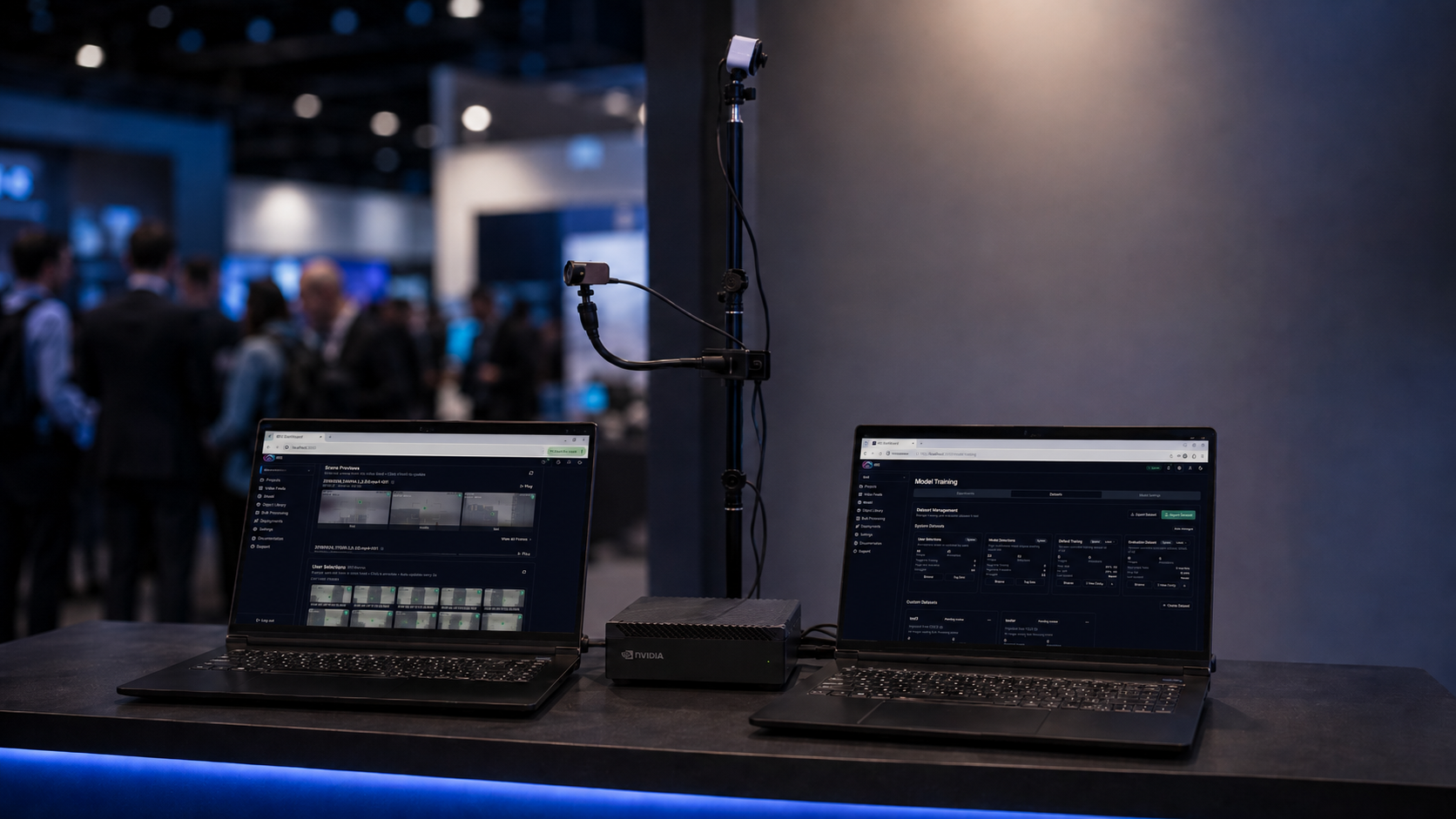
WESTMINSTER, Md. — IRIS, the computer vision lifecycle platform developed by AXOLTL, will introduce expanded multi-edge orchestration capabilities at Ai4 2026 in Las Vegas.
The live demonstration will show how teams can manage the computer vision lifecycle across multiple NVIDIA edge devices and video streams—from data ingestion and validation through model experimentation, deployment, feedback, and continuous improvement.
Rather than presenting a model under fixed conditions, the demonstration will show how models can be deployed, evaluated, and updated across a distributed edge environment as part of a continuous operating workflow.
IRIS will also demonstrate its integration with PlayMaker, an orchestration layer developed by AXOLTL to coordinate devices, model deployments, system events, workflows, and human decisions.
“Computer vision rarely fails because a usable model doesn't exist. It fails because everything around the model is fragmented. The data, validation, deployment, monitoring, and improvement process often spans different tools with no clear connection between them. IRIS brings those pieces into one lifecycle. These new orchestration capabilities extend that lifecycle across the devices and environments where computer vision systems actually have to perform.”
Extending the Lifecycle Across Edge Environments
Training a model is only one part of putting computer vision into operation. Once deployed, teams must often manage multiple video feeds, distributed edge devices, changing conditions, model versions, operational feedback, and updates across the system.
At Ai4, IRIS will demonstrate that lifecycle across multiple edge nodes operating in real time. Computer vision models will run locally on NVIDIA devices connected to live camera feeds, while IRIS serves as the central environment for managing data, experiments, deployments, and subsequent improvements.
PlayMaker will provide the supporting orchestration layer, coordinating model deployments, device activity, system events, and the workflows triggered around them.
The demonstration is built around a simple principle: a computer vision system should not stop learning once a model is deployed. It should give teams a practical way to capture what happens in operation, evaluate where performance breaks down, and carry those lessons into the next deployment.
Provence will explore that principle in his Ai4 solo talk, “Computer Vision Is a Lifecycle Problem, Not a Model Problem,” on Wednesday, August 5, 2026, from 2:25 p.m. to 2:35 p.m. on the Startup Stage.
Applying IRIS to Real Manufacturing Workflows
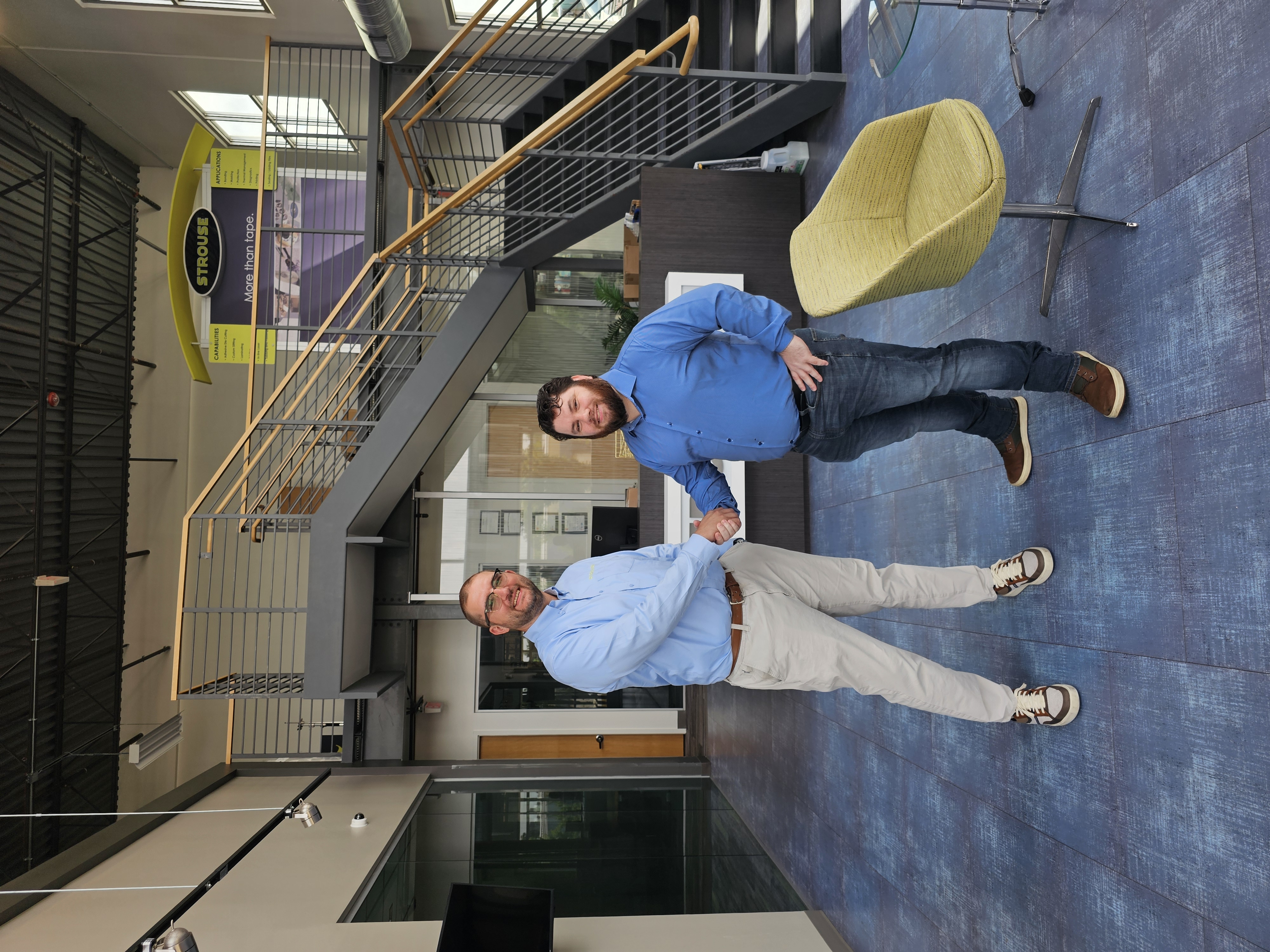
IRIS is also expanding into manufacturing through a new initiative with The Strouse Corporation, a Westminster, Maryland-based manufacturer specializing in adhesive converting and material solutions.
The broader relationship between AXOLTL and Strouse includes practical AI, software automation, and systems integration work across the company's operations. As part of that collaboration, the teams will use IRIS to explore where computer vision can support real manufacturing workflows.
The initial proof of concept will begin with video captured in Strouse's operating environment. IRIS will be used to accelerate annotation, build and refine datasets, compare model approaches, and evaluate potential applications under actual production conditions.
The work will begin with the environment and the workflow rather than a predetermined model or AI feature. The teams will first identify where visual information could improve visibility or decision-making, then test whether computer vision can perform reliably enough to support those needs.
“Manufacturing, like defense and other operational environments, places computer vision systems in conditions that do not remain static. Lighting shifts, materials vary, camera placement changes, and workflows evolve. Our work with Strouse gives us the opportunity to apply IRIS in one of those demanding environments—where long-term value depends not only on how a model performs initially, but on how effectively the system can adapt as conditions change.”
The proof of concept will help the teams evaluate performance, workflow fit, data requirements, and the feedback needed to support future development and deployment decisions.
Moving Beyond One-Time AI Demonstrations
The Ai4 demonstration and the Strouse initiative reflect the same direction for IRIS: helping organizations move beyond isolated models in lab environments and build computer vision systems that can continue improving after deployment.
IRIS connects the stages required to develop and maintain those systems, including video ingestion, candidate discovery, human validation, dataset development, model comparison, deployment, and feedback-driven improvement.
The addition of multi-device orchestration extends that lifecycle across distributed edge environments, giving teams a way to coordinate deployments, capture operational feedback, and apply what they learn to future model versions.
“Teams should not have to start over every time a model encounters something it was not prepared for. Those failures should become useful information—something that can be captured, validated, and used to improve the system. That ability to adapt is what allows computer vision to keep delivering value as the environment changes.”
IRIS will be demonstrated throughout Ai4 2026 at Booth K1032.
About IRIS
IRIS is a computer vision lifecycle platform for building, deploying, and continuously improving computer vision systems. The platform brings together video ingestion, data discovery, human validation, dataset development, model experimentation, edge deployment, and operational feedback in a connected workflow.
IRIS is developed by AXOLTL, a Service-Disabled Veteran-Owned Small Business building adaptive AI systems for commercial and government applications. Learn more at iriscomputervision.ai.
About Strouse
The Strouse Corporation is a Maryland-based manufacturer specializing in adhesive converting and material solutions. The company develops and manufactures precision components for customers across a range of industries and complex applications. Learn more at strouse.com.
Media Contact
Chandler Provence
CEO and Co-Founder
AXOLTL | IRIS